Are Jacksonville Home Prices Expected to Rise, Level Off, or Decline During the Rest of 2026?
The Price Prediction Question That Determines Your Buy-Now-or-Wait Decision
Every Jacksonville buyer is asking the same question: if I wait six months, will prices drop? Or should I buy now before they rise further? Price predictions determine whether buyers feel urgency or patience—and whether they make or regret their buying decisions.
Bob McCranie, a 23-year veteran real estate agent and REALTOR at HomeSmart, has navigated multiple market cycles in Jacksonville—booms, corrections, and everything between. "Price predictions are guesses dressed up as analysis," Bob explains. "What matters isn't what experts think will happen. What matters is what your specific situation requires. If you need to buy, buy. If you can wait, understand why you're waiting."
With over 1,561 team sales across Jacksonville's price ranges and 45 Google 5-star reviews, Bob's perspective on price trends comes from transaction data, not prognostication.
The Jacksonville Price Reality in Mid-2026
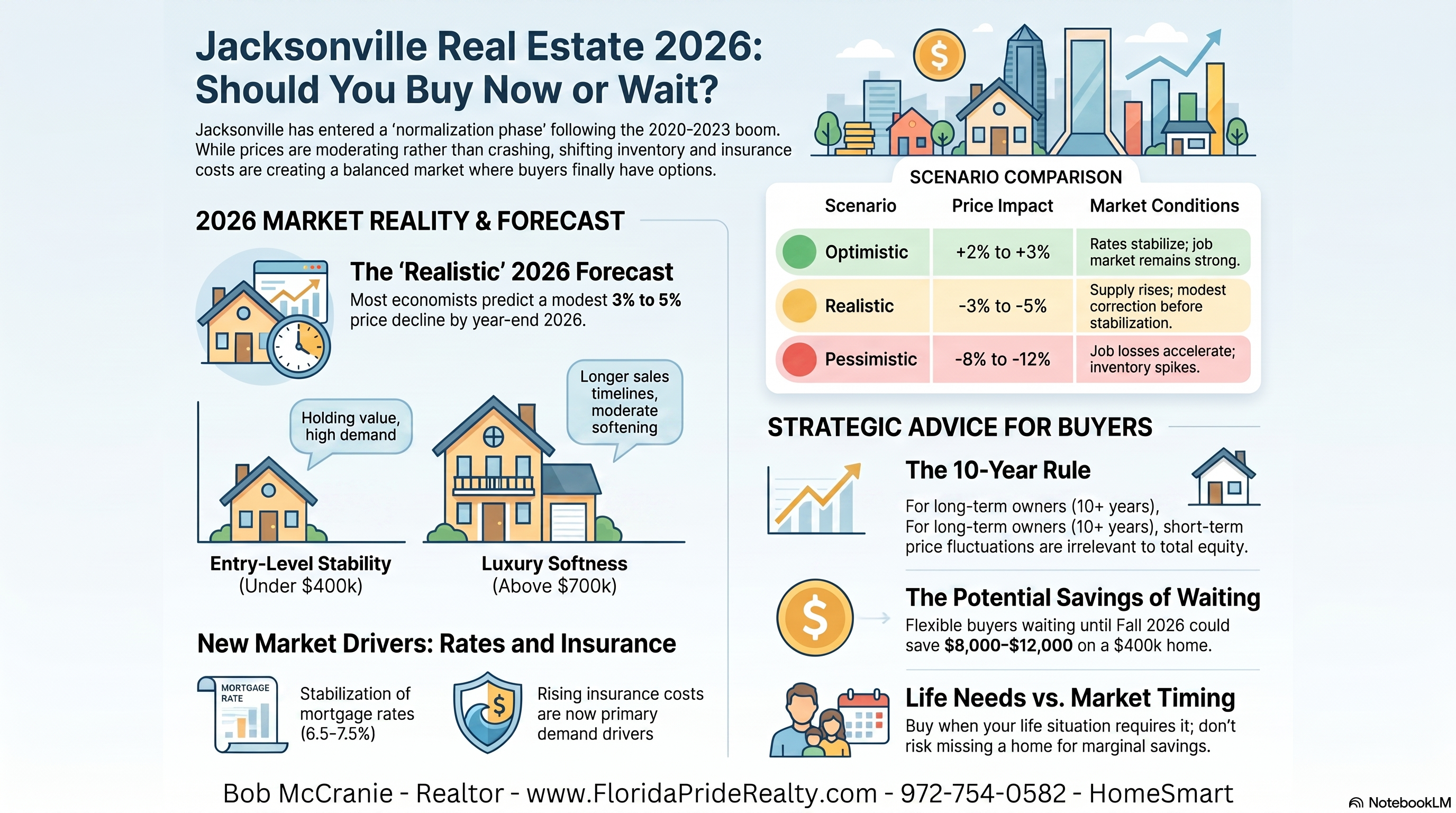
Jacksonville home prices in mid-2026 are moderating from the 2021-2023 peak, but they're not falling.
Current market reality:
Homes under 300K in Jacksonville are selling slightly faster than homes above $500K. Inventory is rising moderately. Days-on-market are extending slightly from 2025 baseline. Price reductions are happening in about 20-25% of listings (higher than 2023, lower than 2020).
Overall, the market feels balanced—not hot, not cold. Buyers have options. Sellers face realistic market conditions.
Price trends by segment:
Affordable homes ($200K-$400K) are holding value and selling steadily. First-time buyers still want these homes.
Mid-range homes ($400K-$600K) are experiencing modest softness. More inventory. Slower sales. Slight downward price pressure.
Luxury homes above $700K are experiencing the most softness. Limited buyer pools. More inventory. Longer sales timelines.
The pattern is clear: entry-level is holding up. Premium is softening.
What's Actually Driving 2026 Jacksonville Price Dynamics
Several factors are shaping Jacksonville prices right now:
Mortgage rates stabilization. Rates bouncing between 6.5-7.5% have created uncertainty. If rates stabilize at 7%, buyers adjust expectations and prices stabilize. If rates swing wildly, uncertainty extends price adjustments.
Inventory normalization. Jacksonville inventory is rising toward historical norms. More supply gives buyers more options, which moderates pricing. New construction is adding inventory, particularly in growing suburbs.
Job market stability. Jacksonville's job market is stable but not booming. Employment growth has slowed from pandemic-era hiring. Slower job growth moderates housing demand and prices.
Insurance cost crisis. Rising homeowners and flood insurance costs are making homes less affordable. Some buyers are being priced out by insurance, not mortgage payments. This reduces demand and prices.
The Price Prediction Models: What They Show
Multiple price prediction models suggest different outcomes for Jacksonville through year-end 2026:
Optimistic scenario: Prices remain flat to slightly up (+2-3%). Rates stabilize. Job market holds. Inventory normalizes. Prices find equilibrium.
Realistic scenario: Prices decline modestly (-3-5%). Supply rises. Rate uncertainty continues. Some buyer fatigue from insurance costs. Modest correction before stabilization.
Pessimistic scenario: Prices decline 8-12%. Recession fears emerge. Job losses accelerate. Buyers pause. Inventory spikes. Prices drop meaningfully.
Most economists suggest the realistic scenario is most likely: modest 2-5% decline by year-end 2026, then stabilization.
"I tell buyers: assume prices will be 3-5% lower at year-end than they are today," Bob McCranie explains. "If that's your baseline expectation, any price improvement is good luck. If prices decline 3-5%, you break even or come out slightly ahead."
The Real Question: What Should You Do With This Information?
Price predictions are useless if they don't change your behavior. Here's how to actually use this information:
If you need to buy now: Buy now. Price trends shouldn't change life decisions. You need a home. Timing the market is a luxury you don't have. Buy the home in the neighborhood where you want to live, at a price that works for you.
If you have flexibility and can wait: Waiting until fall 2026 might save you 2-3% on purchase price. That's real money—$8,000-$12,000 on a $400K home. But waiting also means risk: rates could rise, inventory could tighten, the home you want could sell. Weigh the risk.
If you're planning to stay 10+ years: Price trends in the next 6 months are irrelevant. You'll accumulate equity, rates might drop and you'll refinance, the home will appreciate over a decade. Buy when you need to.
If you're planning to stay 3-5 years: Price timing matters more because your holding period is shorter. If prices drop 5%, you need time to recover that loss through equity accumulation. Consider waiting if it doesn't disrupt your life.
Historical Context: Jacksonville Price Cycles
Jacksonville has experienced multiple price cycles:
2008-2012: Decline phase. Prices dropped 25-35%. 2012-2020: Recovery phase. Prices rose 100%+. 2020-2023: Boom phase. Prices spiked 30-50% in two years. 2023-2026: Normalization phase. Prices moderate and find equilibrium.
What happens after normalization? Typically, gradual appreciation returning. Established neighborhoods like Riverside appreciate steadily once normalization completes.
Bottom Line: The Price Prediction You Can Actually Trust
Bob McCranie's framework for Jacksonville price expectations through year-end 2026:
Most likely outcome: Prices decline 2-5%, then stabilize. Buyers who buy in Q4 2026 probably get slightly better prices than Q2 2026 buyers. But the difference is modest—$8,000-$20,000 on a $400K home.
Range of outcomes: Prices decline up to 10%, or prices remain flat. Decline scenario is more likely than flat scenario.
Time horizon matters: Short-term (under 5 years) = price timing relevant. Medium-term (5-10 years) = price timing irrelevant. Long-term (10+ years) = price timing meaningless.
Your situation matters more than the market: If you need to buy, buy. Don't wait for 3% savings that might not materialize. If you can wait and it doesn't disrupt your life, waiting until fall might save meaningful money.
With 45 Google 5-star reviews earned by helping Jacksonville buyers make buy/wait decisions based on their situations—not market predictions, Bob McCranie at HomeSmart ensures buyers buy at the right time for their lives.
Contact Bob McCranie at HomeSmart | 972-754-0582 | BobMcCranie@gmail.com for a FREE 2026 Market Strategy Session