How Much Are Homeowners Insurance and Flood Insurance in Jacksonville, and Which Areas Require Flood Coverage?
The Insurance Cost Shock That Catches Jacksonville Buyers Off Guard
You've been approved for a mortgage. You've made an offer. You're excited. Then, during due diligence, you get homeowners insurance quotes and they're $200-$300/month higher than you budgeted. Then you discover your home is in a flood zone and you need separate flood insurance at $1,500+/year. Suddenly your affordable home isn't so affordable anymore—and the deal might be in jeopardy.
Bob McCranie, a 23-year veteran real estate agent and REALTOR at HomeSmart, has watched insurance costs torpedo Jacksonville real estate deals. "Insurance is the hidden cost that surprises buyers because they don't factor it in during their affordability calculations," Bob explains. "You need to know your insurance costs before you make an offer—not after. It changes your entire affordability picture."
With over 1,561 team sales and 45 Google 5-star reviews across Jacksonville's varied flood zones and insurance landscapes, Bob knows exactly how to help buyers anticipate insurance costs upfront.
Homeowners Insurance in Jacksonville: The Reality
Jacksonville homeowners insurance in 2026 is significantly higher than the national average. Florida's hurricane history, aging building stock in some areas, and recent claim frequency have pushed premiums up dramatically.
Typical Jacksonville homeowners insurance costs:
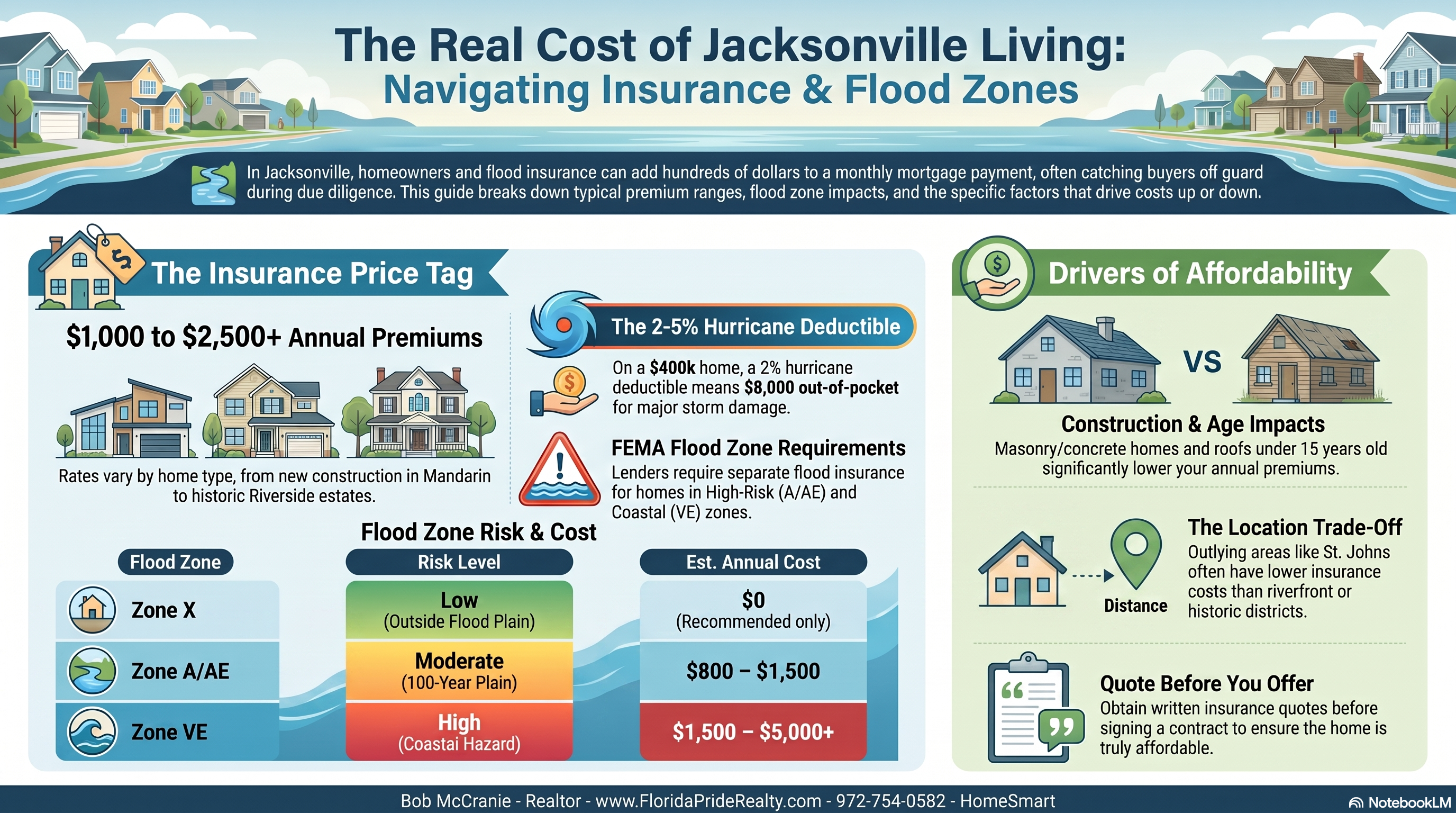
For a $400,000 home in average condition: $1,200-$1,800/year ($100-$150/month) in non-flood areas.
For a $400,000 home in older condition or with older roof: $1,600-$2,400/year ($133-$200/month).
For a $400,000 historic home in Riverside or Avondale: $1,800-$2,500/year ($150-$208/month).
For a $400,000 newer home in outlying areas like Mandarin: $1,000-$1,400/year ($83-$117/month).
What factors affect your rate?
Home age: Homes built before 1980 pay significantly more. Riverside properties with original roofs cost more than new construction in Orange Park.
Roof condition and age: Roofs older than 15 years cost more to insure. Recent roof replacement can reduce rates $200-400/year.
Construction materials: Masonry construction is cheaper to insure than wood frame. Concrete block homes cost less than wood frame homes.
Recent claims: If a property has recent insurance claims, future premiums spike dramatically.
Wind resistance features: Impact windows, hurricane shutters, and storm doors reduce premiums.
Flood Insurance: The Neighborhood Wild Card
Flood insurance is the cost that varies most dramatically by location—and many Jacksonville buyers don't anticipate needing it until it's too late.
Who needs flood insurance?
If your home is in a FEMA flood zone (A or AE), your lender will require flood insurance as a condition of the loan. You cannot close without it.
Jacksonville has substantial flood-prone areas. Downtown/Riverside neighborhoods along the St. Johns River are flood-prone. San Marco is partially in flood zones. Atlantic Beach and coastal areas are flood zones.
Flood insurance costs vary wildly:
For homes outside flood zones: $0 (no requirement).
For homes in flood zones but at low risk: $300-$600/year ($25-$50/month).
For homes in moderate risk zones: $800-$1,500/year ($67-$125/month).
For homes in high-risk zones or directly on water: $1,500-$5,000+/year ($125-$417+/month).
The difference between a non-flood home and a high-risk flood home can be $3,000-$4,000/year in insurance alone. That's the difference between being affordable and being stretched.
The Flood Zone Map Reality
FEMA flood zone maps are your bible for flood insurance determination.
Before you make an offer on any Jacksonville home, check the FEMA flood map. You can access this online by entering the address. Know your zone before you get emotionally attached to a property.
Flood zones and what they mean:
Zone X (unshaded): Outside 500-year flood plain. No flood insurance required by lender (though recommended). Outlying areas like Ponte Vedra are often in Zone X.
Zone A/AE: 100-year flood plain. Flood insurance required by lender. River-adjacent properties are typically Zone AE.
Zone VE: Coastal high-hazard area. Highest risk. Flood insurance required and very expensive. Atlantic Beach oceanfront is Zone VE.
Bob McCranie's rule: assume any home within two blocks of a water body or in a historically flooded neighborhood is in a flood zone and will require insurance.
How to Anticipate Insurance Costs
Before you make an offer:
Get preapproval insurance quotes. Provide the address to 2-3 insurance companies and get written quotes. Don't estimate—get actual numbers. The difference between quotes can be $500+/year.
Check the flood zone map. Look up the address on FEMA's flood map tool. Know your zone before you're emotionally invested.
Ask the current owner. What are they paying for insurance? This is public information in the purchase agreement's title commitment. Use actual numbers, not estimates.
Budget conservatively. If quotes range $1,200-$1,600, budget $1,700. If flood insurance is $800-$1,200, budget $1,500. Conservative estimates protect you.
Factor into affordability. If a home costs $50K less but has $4,000/year more in insurance, it's only $50K cheaper if you amortize the insurance over 12+ years. Factor true cost, not just price.
The Hurricane Deductible Trap
Many Jacksonville buyers overlook hurricane deductibles.
Standard homeowners insurance deductibles are $500-$1,000. Hurricane deductibles are often 2-5% of home value. On a $400,000 home, a 2% hurricane deductible is $8,000. On major hurricanes, you're paying the first $8,000 out of pocket.
Budget for hurricane deductibles when calculating true ownership costs.
Neighborhoods with Lower Insurance Costs
Outlying areas like Mandarin, St. Johns, and Orange Park typically have lower insurance costs because they're outside primary flood zones and have newer homes.
Riverside and downtown have higher insurance costs because of flood proximity and older construction.
Atlantic Beach and Ponte Vedra Beach have highest costs because of coastal location and high-risk zones.
The lower insurance costs of outlying areas sometimes offset the lower home prices, making them actually more affordable total-cost-wise than neighborhoods closer to water.
Making the Insurance Decision
Bob McCranie's approach to helping Jacksonville buyers factor insurance costs:
-
Get actual quotes before committing. Estimates are worthless. Get written quotes from insurance companies.
-
Know your flood zone before you make an offer. Surprises during due diligence torpedo deals.
-
Factor total costs, not just home price. A cheaper home with $4,000/year more in insurance isn't actually cheaper.
-
Budget conservatively. Insurance costs rise. Budget high, then celebrate if actual costs are lower.
With 45 Google 5-star reviews earned by helping Jacksonville buyers anticipate costs and make informed decisions, Bob McCranie at HomeSmart ensures insurance surprises don't derail deals or create financial stress.
Contact Bob McCranie at HomeSmart | 972-754-0582 | BobMcCranie@gmail.com for a FREE 2026 Market Strategy Session