How Much House Can You Realistically Afford with Today's Mortgage Rates, Taxes, Insurance, and HOA Fees?
The Affordability Question That Separates Fantasy from Reality
Your lender says you can afford $450,000. Your real estate agent shows you homes up to $450,000. But can you actually afford them? There's a massive difference between what lenders will finance and what you can comfortably afford—and that difference is the gap where buyers get into trouble.
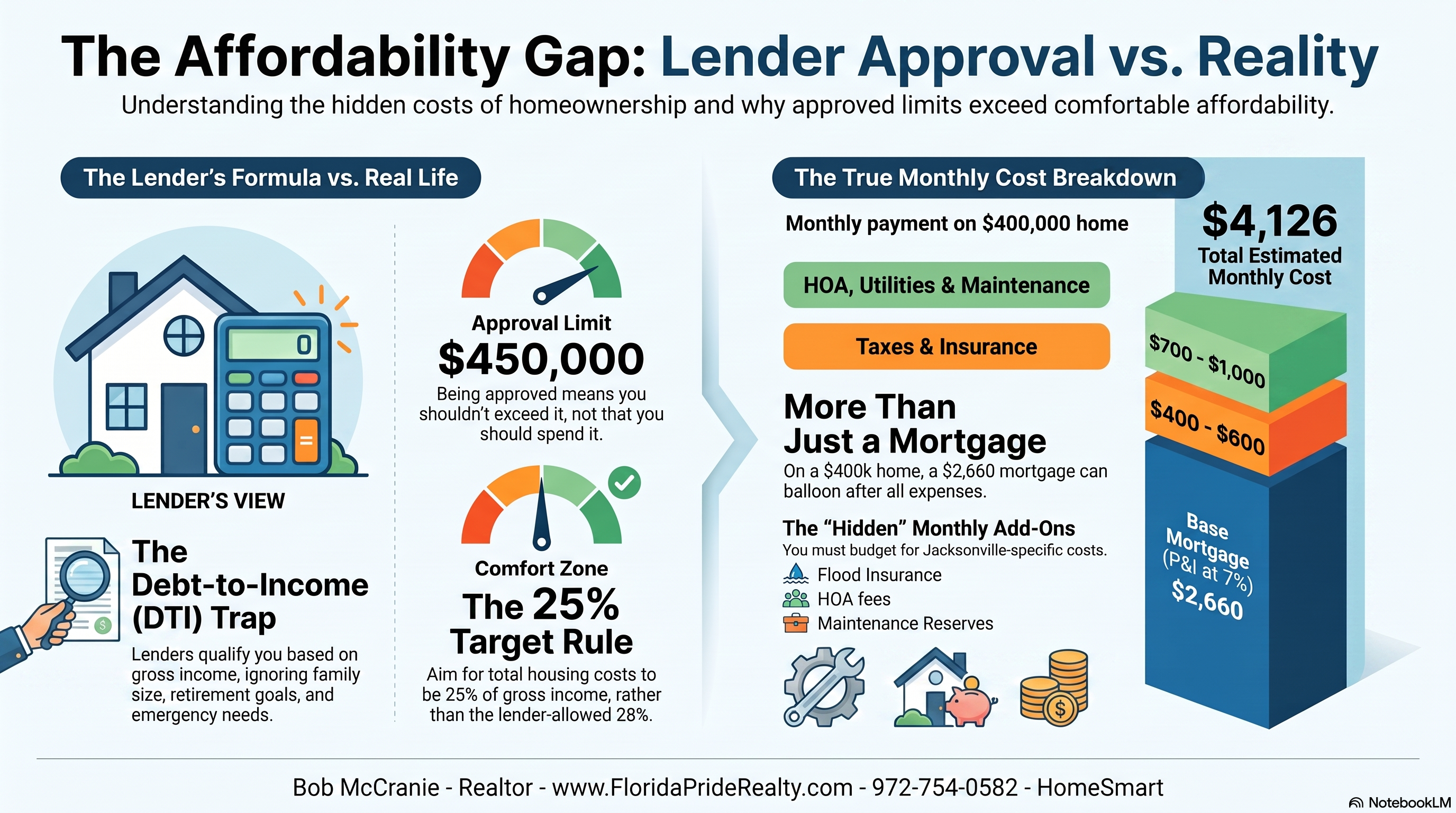
Bob McCranie, a 23-year veteran real estate agent and REALTOR at HomeSmart, has watched countless Jacksonville buyers get approved for more than they can afford and then panic when actual monthly costs arrive. "Lenders qualify you based on debt-to-income ratio," Bob explains. "They don't factor your actual life—your family size, your retirement savings goals, your emergency fund needs. A lender saying you can afford $450,000 doesn't mean you should buy $450,000. It means you shouldn't exceed $450,000."
With over 1,561 team sales and 45 Google 5-star reviews, Bob's perspective on true affordability comes from watching Jacksonville buyers live with their purchase decisions—not from lending formulas.
The Full Cost of Home Ownership That Lenders Don't Emphasize
Most buyers focus only on their mortgage payment. That's the mistake that creates financial stress.
Mortgage payment (principal and interest): On a $400,000 loan at 7% for 30 years = roughly $2,660/month. This is just the start.
Property taxes in Jacksonville: Varies by neighborhood but roughly 0.8-0.9% of home value annually. On $400,000, that's $3,200-$3,600/year or $267-$300/month. Riverside homes have different tax rates than outlying areas.
Homeowners insurance: Jacksonville ranges $1,200-$2,000/year depending on home age, condition, and location = $100-$167/month. Older historic homes might cost more to insure.
Flood insurance (if required): Many Jacksonville areas require it. $500-$2,000+/year depending on flood zone = $42-$167/month. Riverside properties have different flood risk than Atlantic Beach homes.
HOA fees (if applicable): Varies widely but $200-$500/month in Jacksonville gated communities.
Maintenance and repairs: Budget 1-2% of home value annually. On $400,000, that's $4,000-$8,000/year or $333-$667/month.
Utilities: $150-$250/month depending on efficiency and usage.
Total realistic monthly costs on $400,000 home: Mortgage ($2,660) + taxes ($283) + insurance ($133) + flood insurance ($100) + utilities ($200) = $3,376 minimum. Add HOA ($350 if applicable) and maintenance reserves ($400) and you're at $4,126/month.
That's very different from just the mortgage payment.
The Debt-to-Income Ratio Trap
Lenders typically approve buyers where housing costs don't exceed 28% of gross monthly income. Sounds reasonable. It's not.
If your gross monthly income is $8,000, lenders will approve you for up to $2,240 in housing costs. But your true total costs are $4,126. You're already over the lender's comfort zone before factoring in car payments, student loans, credit cards, and actual life.
"Lenders maximize how much they can lend you," Bob McCranie explains. "That's their business model. But you need to leave yourself breathing room—for emergencies, for life changes, for not being stressed about money every month. Borrow less than the maximum. It's the difference between being approved and being comfortable."
The Real Affordability Formula
Here's how to calculate what you can actually afford:
Step 1: Determine your gross monthly household income. If you make $120,000/year, that's $10,000/month gross.
Step 2: Calculate your target housing cost (25% of gross income, not lender's 28%). 25% of $10,000 = $2,500/month. This is your total housing cost budget including mortgage, taxes, insurance, utilities, HOA.
Step 3: Back into your affordable home price. Working backward from $2,500 total cost, determine your maximum affordable mortgage. Subtract estimated taxes ($200), insurance ($100), utilities ($150), and HOA ($0-300). That leaves roughly $1,750-$2,050 for mortgage payment.
On a $1,750 mortgage payment at 7% interest, you can afford roughly $260,000. On a $2,050 payment, roughly $305,000.
Step 4: Account for down payment. If you have $50,000 down payment, you can buy a $310,000 home (needing $260K financed) or $355,000 home (needing $305K financed).
This is far more conservative than lender approval, but it's realistic.
The Hidden Costs Buyers Forget
Several costs surprise Jacksonville homebuyers:
PMI (Private Mortgage Insurance): If you put down less than 20%, you pay PMI. $0.5-1.0% of loan amount annually. On a $300,000 loan with 10% down, that's $150-300/month until you reach 20% equity.
Homeowners association fees increasing. Many Jacksonville communities raise HOA fees 3-5% annually. Budget for increases.
Special assessments. HOA communities sometimes impose surprise assessments for major repairs (roof, pool, common area). Budget $100-200/month reserve for potential assessments.
Home warranty costs. Some buyers purchase home warranties ($400-600/year) for peace of mind. It's optional but something to budget.
Neighborhood Impact on Affordability
Your neighborhood dramatically affects your actual costs.
Riverside homes have higher property taxes than outlying areas. Waterfront properties have flood insurance costs inland homes don't. Condos have HOA fees single-family homes don't.
The home price is just one piece. Total cost varies dramatically by location and property type.
The Conservative Approach to Affordability
Bob McCranie's rule for Jacksonville buyers:
Lender approval = maximum, not target. If lenders approve you for $450,000, buy $350,000-$380,000 instead. The difference is breathing room—for emergencies, for quality of life, for not stressing about money.
Budget conservatively. Estimate property taxes and insurance high. Estimate interest rates high. Budget $500+/month for maintenance even if your home is new. Conservative estimates protect you when reality is harsher.
Leave emergency fund intact. Don't drain your savings for down payment. Keep 6-12 months of expenses in reserve. Homeownership surprises you. Emergency funds prevent panic.
Plan for life changes. Jobs change. Family size changes. What's affordable today might not be affordable if income drops. Buy conservatively enough that income changes don't create crisis.
With 45 Google 5-star reviews earned by helping Jacksonville buyers understand true affordability—not just lender approval, Bob McCranie at HomeSmart ensures buyers make sustainable purchasing decisions.
Contact Bob McCranie at HomeSmart | 972-754-0582 | BobMcCranie@gmail.com for a FREE 2026 Market Strategy Session