How Much Will I Need to Negotiate on Closing Costs, Repairs, or Buyer Concessions in Tampa?
The 2026 Negotiation Landscape Tampa Sellers Must Navigate
The days of "no concessions, take it or leave it" are over in Tampa's 2026 real estate market. Buyers have leverage again. They're asking for closing cost credits. They're requesting repair allowances after inspection. They're negotiating appraisal gaps when values come in low. And sellers who refuse to negotiate at all are watching deals fall apart and homes sit.
Bob McCranie, a 23-year veteran real estate agent and REALTOR at HomeSmart, sees negotiation dynamics shift constantly across Tampa's submarkets. "The best outcome isn't refusing all concessions," Bob explains. "It's understanding which concessions are standard, which are negotiable, and which are attempts to renegotiate the entire deal through the back door."
With over 1,561 team sales and extensive negotiation experience across all price ranges, Bob knows exactly how to position Tampa sellers for strong outcomes without losing deals to inflexibility.
What's Standard vs. What's Aggressive in 2026 Tampa
Not all buyer requests are equal. Some are market-standard expectations in 2026. Others are attempts to extract additional value beyond what's reasonable.
Standard requests sellers should expect:
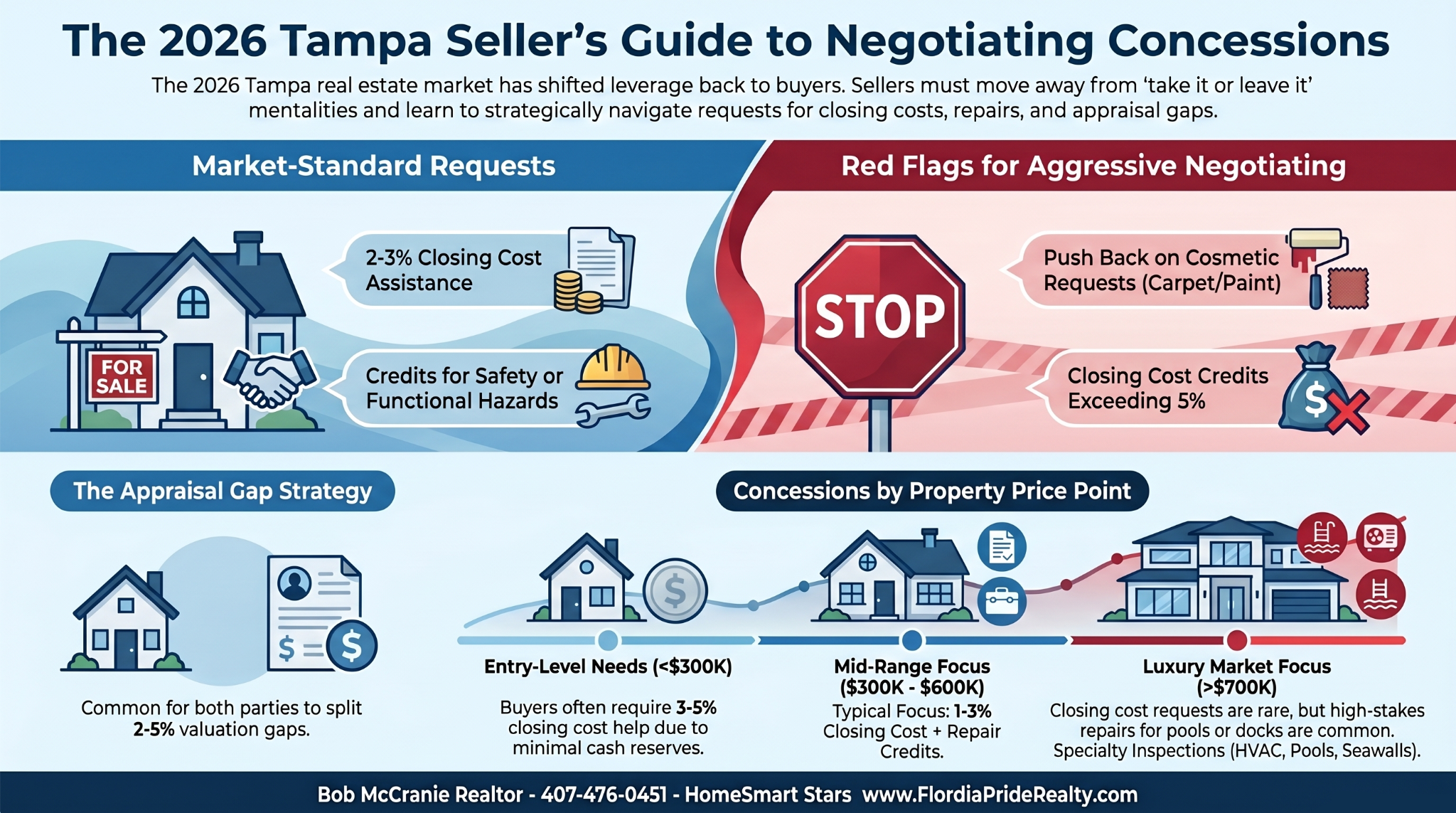
Closing cost assistance of 2-3% on Tampa FL homes under 300K. First-time buyers and entry-level purchasers often need help with closing costs to make deals work. This is normal, anticipated, and should be factored into your net proceeds planning from day one.
Repair credits or completion for items identified in inspection. If the inspection reveals a non-functional AC, roof leak, or electrical hazard, buyers will request repairs or credits. This is appropriate and expected—not an insult.
Appraisal gap negotiation when values come in 2-5% low. If your home appraises at $475,000 instead of the $490,000 contract price, buyers will ask sellers to meet somewhere in the middle. This happens more in 2026 than it did in 2021-2022.
Aggressive requests sellers should push back on:
Closing cost credits exceeding 5% combined with full asking price. This is essentially a disguised price reduction. If a buyer offers $500,000 with $25,000 in seller credits, they're really offering $475,000. Price accordingly or decline.
Repair requests for minor cosmetic items. Buyers asking for $5,000 credits because they don't like the carpet color or want different light fixtures are attempting post-contract renegotiation. Push back.
Appraisal gap demands where buyers refuse to contribute anything. If a home appraises $15,000 low and the buyer demands the seller eat the entire difference, that's unreasonable unless the property was clearly overpriced.
"I help sellers separate reasonable negotiation from buyer opportunism," says Bob McCranie. "You accommodate the former and push back on the latter—firmly but professionally."
How Price Range Affects Concession Expectations
Concession norms vary dramatically by price point in Tampa's 2026 market:
Tampa homes under 300K: Expect 3-5% closing cost requests routinely. Buyers in this segment often need maximum financing and minimal cash at closing. Build this into pricing strategy upfront.
Tampa homes under 600K: 1-3% closing cost requests are common. Repair negotiations are standard. Appraisal issues require case-by-case evaluation.
Tampa luxury homes above $700K: Closing cost requests are rare (these buyers have cash). But repair negotiations and high-dollar specialty inspection items (pool equipment, dock/seawall, HVAC systems) are more common and higher stakes.
Bob McCranie at HomeSmart prices homes in each segment to account for typical concession patterns, ensuring sellers net what they need regardless of negotiation dynamics.
Inspection Negotiations: Where Most Tampa Deals Get Tense
The inspection period is where seller-buyer relationships either strengthen or fracture in Tampa's 2026 market. Understanding how to handle inspection negotiations separates successful sellers from frustrated ones.
Expect inspection reports to list 20-40 items. Home inspectors are paid to find issues. They will find issues. A long inspection report doesn't mean your home is defective—it means the inspector did their job.
Distinguish between safety/functional issues and cosmetic preferences. A roof leak, faulty wiring, or non-functional AC? Legitimate repair requests. Worn carpet, dated countertops, or paint colors? Not repair issues—those are preferences buyers should have factored into their offer.
Get repair quotes before agreeing to credits. If a buyer requests $8,000 for "AC issues" and you get a quote showing repair costs $3,500, use that data in negotiation. Don't accept inflated credit requests without verification.
Consider offering credits vs. completing repairs. Many Tampa sellers find offering closing cost credits for buyers to handle repairs post-closing easier than coordinating contractor work during the contract period. Buyers often prefer this too—it gives them control over contractor selection and work quality.
"The inspection negotiation isn't about nickel-and-diming," Bob McCranie explains. "It's about fairness and good faith on both sides. I've salvaged dozens of deals by reframing inspection discussions from adversarial to collaborative."
The Appraisal Gap Challenge
Appraisal gaps—where the appraised value comes in below the contract price—are happening more frequently in Tampa's 2026 market as prices moderate from 2021-2022 peaks.
How gaps typically get resolved:
Seller reduces price to appraised value: Most common when the property was clearly overpriced or the appraisal is accurate.
Buyer brings additional cash to close the gap: Common when buyers are motivated and confident the home is worth the contract price despite the appraisal.
Both parties split the difference: Seller drops $5,000, buyer brings $5,000 additional cash, deal moves forward.
Deal falls apart: Happens when neither party will budge and emotions override economics.
Bob McCranie at HomeSmart helps sellers evaluate appraisal gap scenarios strategically: Is the appraisal legitimate? Does the deal still work at the appraised value? Are there alternative buyers if this one walks? These questions determine negotiation strategy.
Seller Concessions on Different Property Types
Concession expectations vary by Tampa property type:
Tampa condos: HOA document review often reveals special assessments or reserve issues prompting buyer requests for credits. Be prepared to negotiate these if they surface.
Tampa waterfront homes: Dock, seawall, and water system inspections often identify expensive repairs. Budget for potential five-figure repair negotiations in waterfront transactions.
Tampa homes with pools: Pool equipment, screening, and surface condition are common negotiation points. $2,000-$5,000 credits for pool repairs are routine.
Tampa new construction resales: Buyers often expect builder-level service and concessions. Manage expectations clearly—you're a resale seller, not a builder.
When to Hold Firm and When to Bend
Not every negotiation requires concession. Bob McCranie's framework for Tampa sellers:
Hold firm when: The request is unreasonable, contradicts the as-is contract terms, or attempts to renegotiate price through manufactured issues.
Bend when: The request is reasonable, the deal economics still work, and refusing risks losing a qualified buyer in a softening market.
Walk away when: The buyer is clearly attempting to extract maximum value through bad faith, and accommodating them still leaves you below acceptable proceeds.
With 45 Google 5-star reviews and 23 years negotiating Tampa transactions, Bob McCranie at HomeSmart ensures sellers understand when concessions strengthen deals and when they signal buyer problems that won't end at closing.
Contact Bob McCranie at HomeSmart | 972-754-0582 | BobMcCranie@gmail.com for a FREE 2026 Market Strategy Session