Should You Buy New Construction or an Existing Home in Jacksonville This Summer?
The New vs. Existing Decision That Shapes Your Entire Ownership Experience
You're comparing a new construction home in Nocatee with builder incentives against an existing home in Riverside needing updates. New feels safe—warranty coverage, modern finishes, no surprises. Existing feels risky—inspection issues, hidden problems, potential repairs. But the reality is more nuanced, and the choice depends on your situation, not just your comfort level.
Bob McCranie, a 23-year veteran real estate agent and REALTOR at HomeSmart, has guided Jacksonville buyers through this decision for decades. "New construction and existing homes serve different buyer profiles," Bob explains. "New isn't automatically better. Existing isn't automatically cheaper. You need to understand what each actually gives you—and what you're actually paying for."
With over 1,561 team sales including extensive experience with both new and existing properties, and 45 Google 5-star reviews, Bob's perspective on new vs. existing comes from watching buyers live with their choices.
The New Construction Advantage: What It Really Gives You
New construction homes appeal to buyers for specific, legitimate reasons:
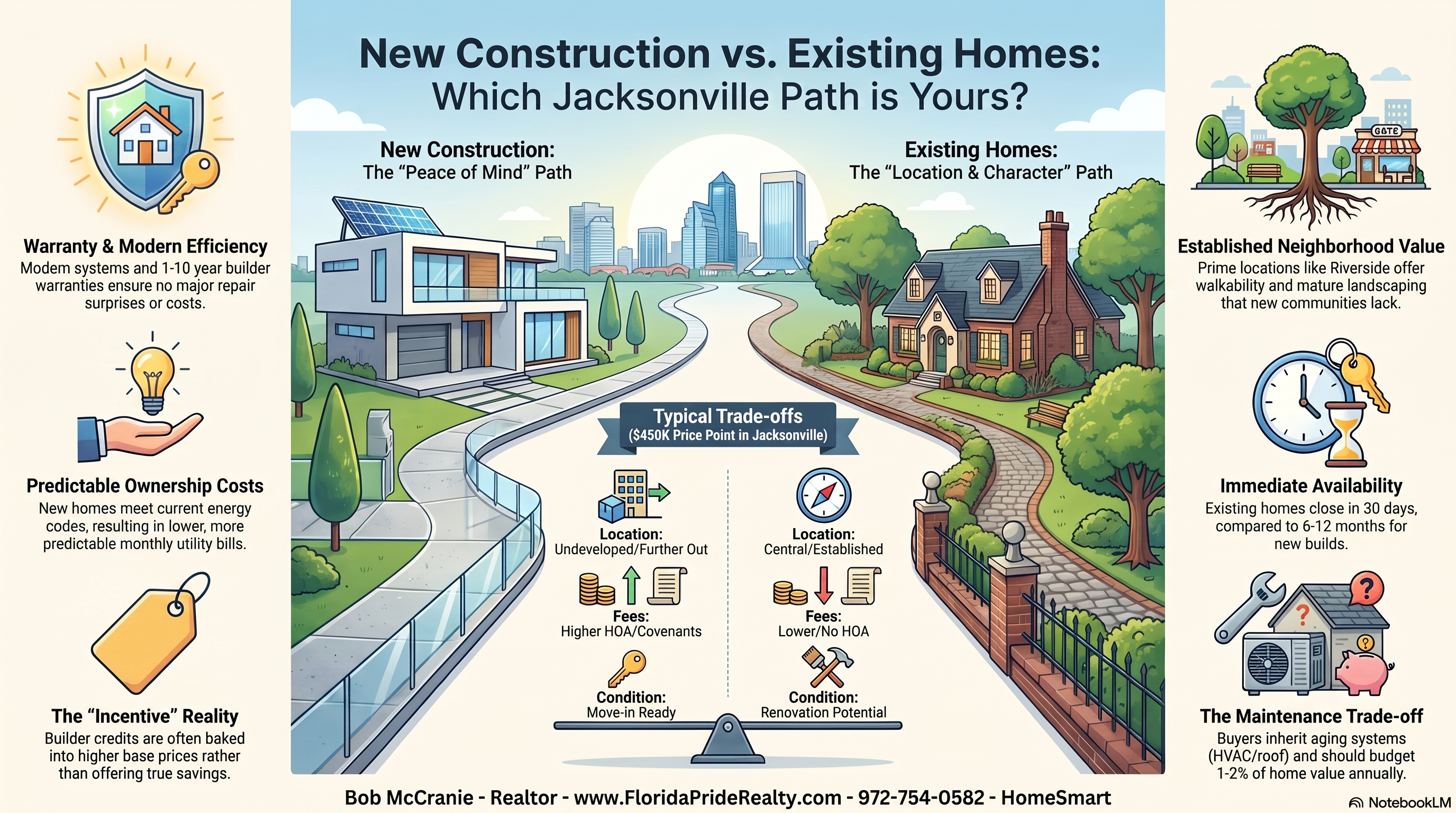
Warranty coverage. Builder warranties cover structural defects and systems for 1-10 years depending on what. You're not responsible for major repairs in year one or two. That peace of mind has value.
No surprises about condition. Everything is new. The roof won't fail. The HVAC works. The electrical system is modern code. You know exactly what you're getting—no inspection discoveries changing your plans.
Modern systems and efficiency. New homes meet current energy codes. They're more efficient than older homes in historic neighborhoods. Your utility bills are predictable and moderate.
Modern design and finishes. Open floor plans. Current aesthetic. No dated tile or fixtures. New homes are move-in ready without personal renovation vision required.
Fewer surprises during inspection. Old wiring? Not in new construction. Outdated plumbing? Nope. Foundation cracks? Unlikely. Inspection reports on new construction are typically clean.
The New Construction Hidden Costs: What It Actually Costs
But new construction comes with costs that offset some perceived advantages:
Builder incentives are baked into higher pricing. That "free $15,000 upgrade package"? The builder added $15,000 to the base price to cover it. You're not getting value—you're paying for it ahead of time.
Closing cost credits reduce your discount. Builders offering $10,000 in closing costs have already padded the price by $10,000+. You're not saving money—you're financing it into the loan.
Builder financing incentives come with strings. Builders offering rate buydowns or temporary rate reductions are charging points and fees. You might get a 6.5% rate temporarily, but you're paying $15,000-$20,000 in points. Calculate the actual cost, not just the rate.
Lot premiums for desirable locations. New construction in premium locations like Riverside doesn't exist. Builders build in less desirable, cheaper land. You might get a new home cheaper than existing Riverside homes, but you're buying a less desirable location to get that discount.
HOA fees and community covenants. New construction communities often have higher HOA fees than established neighborhoods. You're paying for the "new" lifestyle premium.
Builder quality control issues. Rapidly-constructed homes sometimes have quality issues: misaligned doors, cosmetic defects, systems glitches. Many homeowners spend $5,000-$10,000 correcting builder issues in year one.
The Existing Home Advantage: What It Really Offers
Existing homes appeal to buyers for equally legitimate reasons:
Established neighborhoods with character. Riverside, San Marco, and Avondale have character, walkability, and established communities. New construction communities are still being built. Character takes decades.
Better locations for the price. You can buy a home in Riverside for $450,000 that's far superior location-wise to a new home at the same price 20 minutes away in an undeveloped area.
Proven appreciation history. Established neighborhoods have decades of appreciation data. You know they appreciate. New construction communities are unproven. They might appreciate great, or they might stagnate.
Mature landscaping and trees. Established homes have 15-30-year-old trees creating shade and character. New construction starts with saplings.
Immediate availability. You close in 30 days. New construction takes 6-12 months from purchase to occupancy.
The Existing Home Hidden Costs: Understanding True Price
But existing homes come with costs that new construction avoids:
Inspection discoveries requiring negotiation or credits. That $450K home needs $15K roof work, $8K HVAC replacement, foundation cracks. You're negotiating for credits or repairs, not getting a clean, new system.
Older systems with finite lifespans. The roof is 12 years old—good for another 5-8 years, then you replace it ($10K-$15K). The HVAC is 14 years old—good for another 3-5 years, then you replace it ($5K-$8K). You're inheriting aging systems.
Unknown renovation preferences. The previous owner liked popcorn ceilings and carpet. You want open floor plans and hardwood. Renovation costs ($20K-$50K+) are on you.
Deferred maintenance. Caulking is worn. Paint is dated. Landscaping is overgrown. It's all functional, but it needs attention.
Higher ongoing maintenance costs. Older homes require more maintenance. Budget 1-2% of value annually ($4,000-$8,000 on a $400K home).
The Decision Framework: New vs. Existing for Different Buyer Profiles
Buy new construction if:
- You want zero surprises and warranty peace of mind
- You're willing to accept less desirable location for new construction benefits
- You don't want to negotiate after inspection
- You have zero vision for renovation and need move-in ready
- You're not staying more than 5-7 years
Buy existing if:
- You want established neighborhood and proven location
- You have renovation vision and don't mind updating
- You want immediate occupancy
- You're staying 10+ years (old systems become less relevant)
- You want mature landscaping and established community
The Money Reality: Which Is Actually Cheaper?
Let's compare a $450,000 new construction home versus a $450,000 existing home in Jacksonville:
New construction: Might have builder incentives reducing effective price to $420K, but HOA fees are $350/month, and it's 20 minutes farther from downtown.
Existing home: $450K price is real, might need $15K in repairs (reducing effective price to $435K), has mature trees, established neighborhood, walkability, 10 minutes from downtown.
Which is cheaper? Depends if you value location and established community (existing wins) or warranty peace of mind and modern finishes (new wins).
With 45 Google 5-star reviews earned by helping Jacksonville buyers make new vs. existing decisions aligned with their actual priorities, Bob McCranie at HomeSmart ensures buyers choose the home type that genuinely serves their situation.
Contact Bob McCranie at HomeSmart | 972-754-0582 | BobMcCranie@gmail.com for a FREE 2026 Market Strategy Session