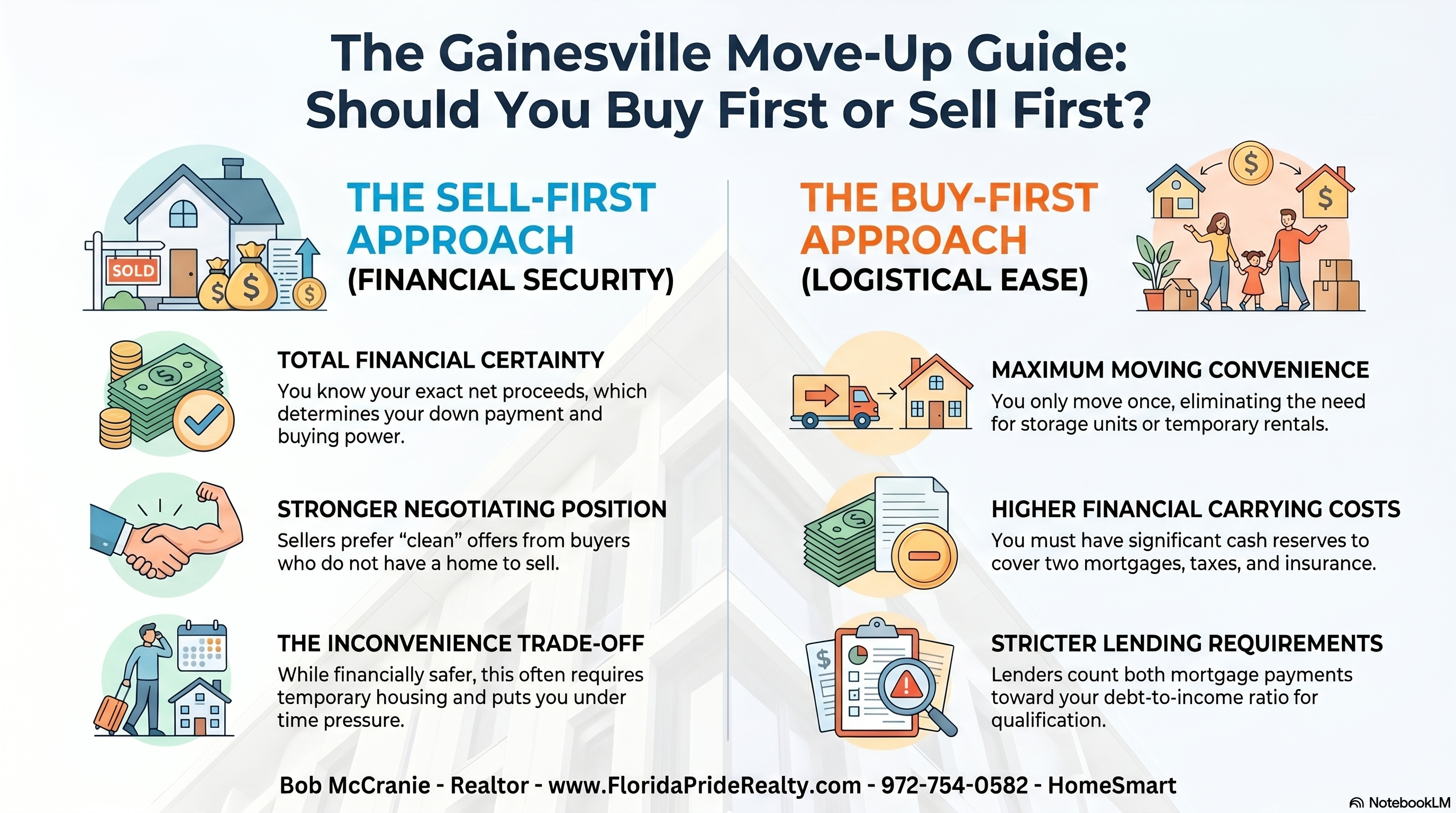
Should You Sell Your Gainesville Home Before Buying Your Next One?
The Timing Dilemma That Keeps Move-Up Buyers Awake at Night
You're ready to move. Maybe you're upgrading to a larger Gainesville home. Maybe you're downsizing to a condo or townhouse. Maybe you're relocating within Gainesville to a different neighborhood. But you face the question every move-up buyer faces: do I sell first and risk being temporarily homeless, or buy first and risk carrying two mortgages?
Bob McCranie, a 23-year veteran real estate agent and REALTOR at HomeSmart, guides Gainesville move-up and move-down buyers through this exact dilemma constantly. "There's no universal right answer," Bob explains. "Your decision depends on your financial position, your local market conditions, and your risk tolerance. But there are clear frameworks that make the decision less agonizing."
With over 1,561 team sales and 45 Google 5-star reviews, Bob knows the pitfalls of both approaches—and how to navigate them successfully in Gainesville's specific market.
The Sell-First Approach: Lower Risk, Higher Inconvenience
Selling your current Gainesville home before purchasing your next one is the financially conservative strategy. It eliminates the risk of carrying two mortgages, gives you certainty about your buying budget, and removes the pressure of needing your sale to close for your purchase to work.
The advantages of selling first:
You know exactly what you're netting. Once your Gainesville home closes, you know your proceeds down to the dollar. That determines your down payment, your new loan amount, and your buying power.
You're a stronger buyer. Sellers of Gainesville luxury homes, waterfront properties, or any competitive listing prefer buyers who don't have homes to sell. You're cleaner. You're faster. You're less risky.
You avoid the nightmare scenario. The worst case—your current home doesn't sell or sells for less than expected, leaving you unable to close on your next home—is eliminated entirely.
The disadvantages of selling first:
You need temporary housing. If your sale closes before you've found and closed on your next home, you're renting an apartment, staying with family, or negotiating a leaseback with your buyer. That creates inconvenience and cost.
You're house-hunting under time pressure. Once your home is under contract, you have 30-60 days to find your next home, negotiate, and close simultaneously. Timeline pressure can force rushed decisions.
You might miss your dream home. The perfect Gainesville property might hit the market while you're in temporary housing—and be gone before you're ready.
"The sellers who succeed with the sell-first approach are the ones who plan temporary housing in advance and give themselves realistic timelines," says Bob McCranie. "Trying to find your next home in 21 days rarely ends well."
The Buy-First Approach: Maximum Flexibility, Maximum Risk
Purchasing your next Gainesville home before selling your current one gives you complete control over timing and eliminates moving twice. But it requires significant financial resources and risk tolerance.
The advantages of buying first:
You move once. Pack your current home, move directly into your new home, no temporary housing, no storage, no logistical nightmares. This appeals to busy professionals and families with school-age children.
You can shop strategically, not desperately. No time pressure. You can wait for the right Gainesville home at the right price rather than settling because your closing deadline is approaching.
You can prep your current home for sale properly. With no occupancy pressure, you can paint, repair, stage, and market your existing home for maximum value rather than listing it occupied and cluttered.
The disadvantages of buying first:
You need significant cash reserves. Two down payments. Two months of double mortgage payments. Two sets of closing costs. You need liquid reserves most Gainesville buyers simply don't have.
You risk not qualifying for the new mortgage. Lenders will count both mortgage payments in your debt-to-income ratio. If that pushes you over qualification limits, your new purchase won't fund—even though you're under contract.
You're under enormous pressure to sell quickly. Carrying two mortgages, two insurance policies, two utilities, and two tax bills is financially unsustainable beyond a few months. That pressure forces price reductions and poor negotiating decisions.
Bob McCranie at HomeSmart runs detailed financial scenarios for clients considering the buy-first approach, ensuring they understand true carrying costs before committing.
Creative Solutions That Actually Work
Beyond the standard approaches, several creative strategies help Gainesville buyers bridge the timing gap:
Home equity line of credit (HELOC) on your current home. Tap equity to fund your next down payment, close on the new home, then pay off the HELOC when your current home sells. Works for homeowners with equity and good credit.
Bridge loans. Short-term financing (6-12 months) using your current home's equity for your next down payment. Higher interest rates but solves timing problems cleanly.
Rent-back agreements with your buyer. Sell your current home but negotiate to rent it back from the buyer for 30-90 days post-closing. Gives you time to find your next home without temporary housing.
Family bridge financing. Borrow down payment funds from family, close on your next home, repay family when your current home sells. Requires family with available capital and clear documentation.
How Gainesville's Summer Market Affects the Decision
Market conditions should influence your sell-first-or-buy-first decision. Summer 2026 in Gainesville has specific dynamics:
If you're a faculty member relocating within Gainesville: Selling first makes sense. Your timeline is academic-calendar driven, inventory is lower in summer, and you'll have clarity about your new position before the fall semester starts.
If you're a student or UF-related buyer: The UF academic calendar dominates your timing, not the real estate season. Plan your move around August move-in dates, not summer market conditions.
If you're a general Gainesville homeowner with flexibility: Fall (September-October) is actually your strongest selling season due to UF demand. If you're not locked into immediate timelines, waiting until fall to list gives you a pricing advantage.
Making the Decision With Real Numbers
Bob McCranie's approach to helping Gainesville buyers make this decision starts with real financial analysis:
-
Calculate true carrying costs of owning both properties for 3 months. Mortgages, insurance, taxes, utilities, maintenance. If that number is unsustainable, sell first.
-
Determine if you qualify for both mortgages at once. Run debt-to-income calculations with both payments. If you don't qualify, buy-first is impossible.
-
Assess your current home's likely sale timeline and price. If your Gainesville home will sell in 30-40 days at predictable price, you can plan around that. If it's in a slow submarket, sell-first reduces uncertainty.
-
Evaluate your risk tolerance honestly. Some buyers sleep fine carrying two mortgages. Others panic. Know yourself.
With 45 Google 5-star reviews earned by orchestrating complex Gainesville transactions, Bob McCranie at HomeSmart ensures buyers make timing decisions based on their specific financial reality—not generic advice.
Contact Bob McCranie at HomeSmart | 972-754-0582 | BobMcCranie@gmail.com for a FREE 2026 Market Strategy Session