What Is the Best Price Strategy for Selling a Home in Gainesville's Current Market?
The Pricing Myth That's Costing Gainesville Sellers Money
There's a widespread myth that pricing high gives you "negotiating room." Start at $525,000 when your home is worth $495,000, the thinking goes, and you'll settle somewhere in the middle. In Gainesville's 2026 real estate market, that strategy is costing sellers weeks on market and tens of thousands in lost negotiating leverage.
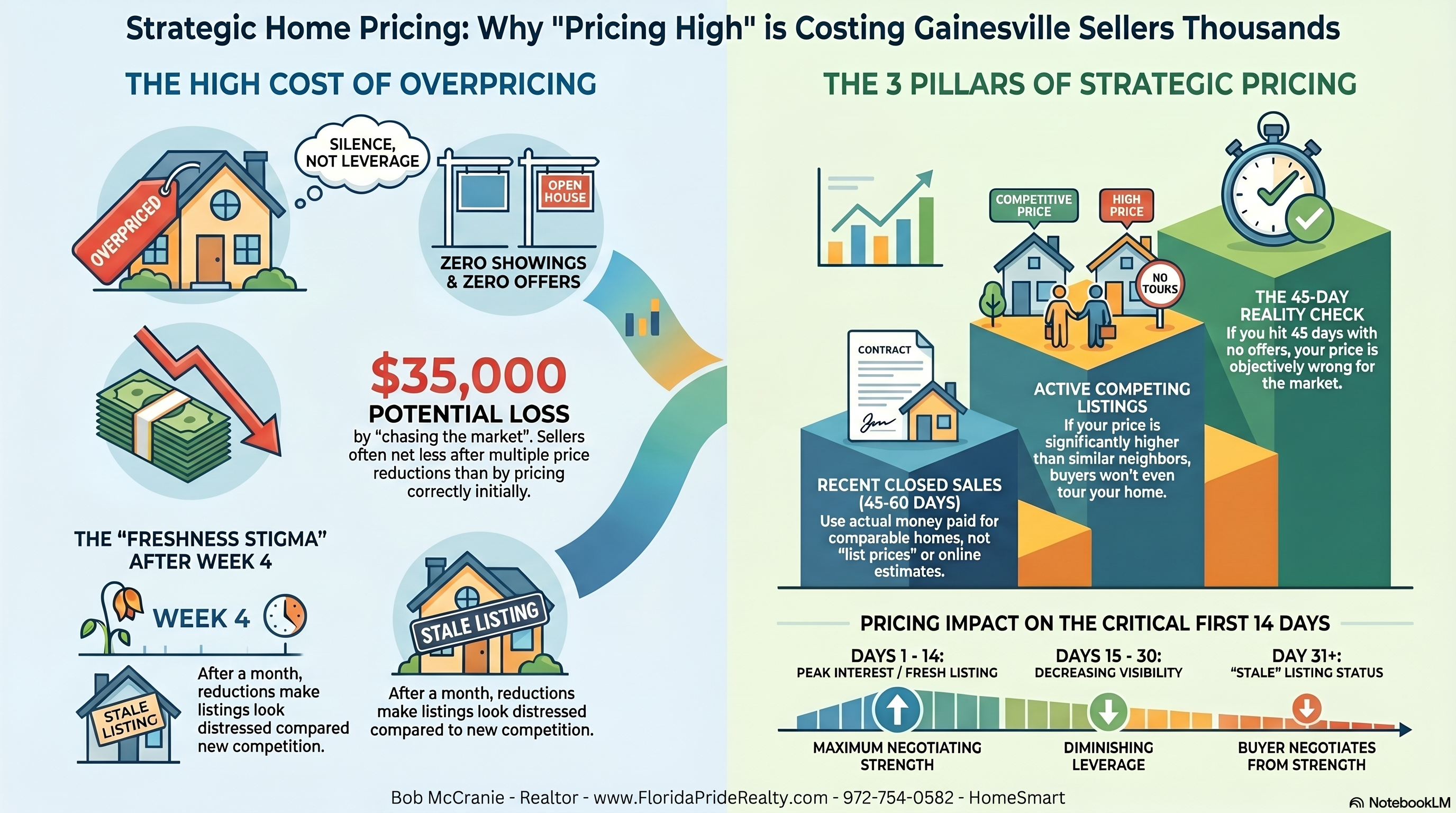
Bob McCranie, a 23-year veteran real estate agent and REALTOR at HomeSmart, watches overpricing destroy sales repeatedly. "Overpriced homes don't generate negotiating leverage," Bob explains. "They generate silence. No showings. No offers. And then, after 30 days, a price reduction that makes your home look distressed even if it's not."
With over 1,561 team sales and 45 Google 5-star reviews, Bob's pricing perspective comes from real Gainesville transaction data—not theory about how pricing "should" work.
Why Overpricing Backfires Worse in 2026 Than It Did in 2022
During Gainesville's 2021-2022 frenzy, overpricing was sometimes forgiven. Buyers were so desperate for inventory that they'd make offers on anything remotely close to their needs—even if the price was ambitious.
That market no longer exists.
In 2026, Gainesville buyers have options. They can compare your home under 600K to five others in the same neighborhood. They can tour your property on Saturday and three competing listings on Sunday. And they're doing exactly that.
When your home is overpriced, here's what actually happens:
Week 1-2: Serious buyers view it online, see the price, check comparable sales, and skip it. "I'll pass at that price" doesn't show up in your showing count—but it's happening constantly.
Week 3-4: The few buyers who do tour leave knowing they can get better value elsewhere. No offers. You start wondering if something's wrong with the house.
Week 5-6: Your agent suggests a price reduction. You resist, thinking you just need the "right" buyer. Meanwhile, every day on market is making your listing look stale.
Week 7-8: You finally cut the price. But now you're competing with fresh listings that just hit the market at your new price—except theirs don't carry the stigma of a reduction.
"I've seen properties net $35,000 less than they would have by pricing correctly from day one," says Bob McCranie. "Not because the market dropped. Because they chased it down with reductions and lost negotiating position every step of the way."
The Data That Actually Drives Pricing Decisions
Forget what you paid. Forget what you think your upgrades are worth. Forget Zillow. Gainesville home pricing comes down to three data sets that matter:
Recent closed sales in your specific neighborhood. Not pending. Not list prices. Actual closed transactions where buyers paid real money in the last 45-60 days for homes comparable to yours. If three Gainesville homes in your area sold for $440,000, $448,000, and $455,000, that's your baseline. Not $485,000 because you have granite counters.
Active competing listings. If four homes similar to yours are listed between $435,000-$465,000, and you list at $495,000, you're not competing—you're self-selecting out of consideration. Buyers will tour the four, make offers on the best one, and never circle back to yours.
Days on market trends for your property type. If homes similar to yours are selling in 30-40 days, that's your baseline. If yours hits day 45 with no offers, your price is wrong—regardless of what you think it should be.
Bob McCranie at HomeSmart runs comprehensive market analyses for every Gainesville listing, pulling all three data sets and overlaying them with property-specific factors like condition, location, and features.
Property Condition and Pricing Alignment
In 2026, condition is no longer forgivable when pricing is ambitious. A dated home in original condition isn't worth the same as a recently updated home—and pretending otherwise by pricing as if it is just extends your time on market.
For dated homes with original features: Price for a buyer willing to update it themselves. That might mean 10-15% below comparable updated homes. That's not a liability—that's accuracy. Buyers understand what they're buying and will be less likely to negotiate aggressively if pricing reflects reality.
For fully updated homes: Price for the premium that condition commands—but only if comparable sales support that premium. A renovated contemporary home with high-end finishes can command premium pricing, but only if market comps prove it.
For homes in transition: A home that's "pretty good" with some deferred maintenance needs honest pricing that accounts for both attributes. Not dated enough to be a fixer, but not updated enough to command premium pricing.
"Honest condition-based pricing sells faster and with less negotiation friction than aspirational pricing," Bob McCranie explains. "Buyers appreciate the honesty, and your expectations align with reality from day one."
Location Micro-Market Pricing
Gainesville isn't one market. It's dozens of neighborhoods with different pricing dynamics—many shaped by UF proximity.
Campus-adjacent student rental zones: Priced on cash flow for investors, not owner-occupant emotion. A property generating $800/month rent is worth significantly more than the same building in a non-rental area. Price for the income.
Faculty-adjacent neighborhoods: Attract stable professional buyers. Pricing is premium based on neighborhood character, school quality, and professional community. These neighborhoods support higher price-per-square-foot than student-adjacent areas.
Established suburban neighborhoods: Price based on family appeal, school quality, and distance from density. Homes with acreage or homes in rural settings get priced for buyers seeking space and quiet.
Waterfront areas: Gainesville waterfront properties command premiums purely based on water access. Condition matters less than location. Price for what waterfront really adds.
Bob McCranie knows which Gainesville neighborhoods support which pricing dynamics based on 23 years of transaction data.
The First Two Weeks Are Everything
The buyers most likely to pay top dollar for your home are active in the market during your listing's first two weeks. They've been searching, they're ready, and they'll tour immediately if your price makes sense.
If you capture those buyers in week one, you're negotiating from strength. Multiple showings. Strong interest. Potentially competing offers if you've nailed the pricing.
If you miss those buyers because you're overpriced, they buy something else. And the next wave of buyers two weeks later sees your listing is already "old" and wonders what's wrong.
Seasonal Pricing Strategy
UF's influence means seasonal pricing in Gainesville works completely differently than the rest of Florida.
Campus-adjacent properties in summer: Expect to price 5-10% more aggressively than you would in fall. Or expect slower sales. Summer is genuinely slower for rental properties.
Fall listings for campus-adjacent properties: You can price closer to your target. September-October brings investor demand. The market is actively looking.
Family-oriented neighborhoods: Respond to traditional spring/fall buyer patterns, not UF academic calendar. Price accordingly for when those buyers are motivated.
With 45 Google 5-star reviews earned by helping Gainesville sellers price accurately from day one, Bob McCranie at HomeSmart ensures sellers understand the real data that drives pricing—and deploy pricing strategies that generate results.
Contact Bob McCranie at HomeSmart | 972-754-0582 | BobMcCranie@gmail.com for a FREE 2026 Market Strategy Session