What Should You Know About Hurricanes, Flood Zones, and Storm Preparedness Before Buying a Home in Jacksonville?
The Storm Reality Check Every Jacksonville Buyer Needs
You're buying your dream home in Jacksonville. It's beautiful. The price is right. The neighborhood is perfect. Then a hurricane warning hits and you watch a local news report about storm surge, evacuation zones, and flood risk. Suddenly you're second-guessing your location choice. Understanding hurricane risk and flood zones upfront—before you buy—is essential. Discovering these issues after closing is expensive, frightening, and too late to change your decision.
Bob McCranie, a 23-year veteran real estate agent and REALTOR at HomeSmart, has guided Jacksonville buyers through hurricane seasons and helped them understand their actual risk. "The key is not fearing hurricanes—it's understanding your specific risk level and building accordingly," Bob explains. "Some Jacksonville locations are genuinely high-risk. Others are relatively safe. You need to know which one you're buying into."
With over 1,561 team sales and 45 Google 5-star reviews across Jacksonville's varied hurricane and flood risk zones, Bob helps buyers make informed location decisions with their eyes open.
Jacksonville's Hurricane Risk: The Reality
Jacksonville experiences hurricanes less frequently than Miami or Tampa, but the risk is real.
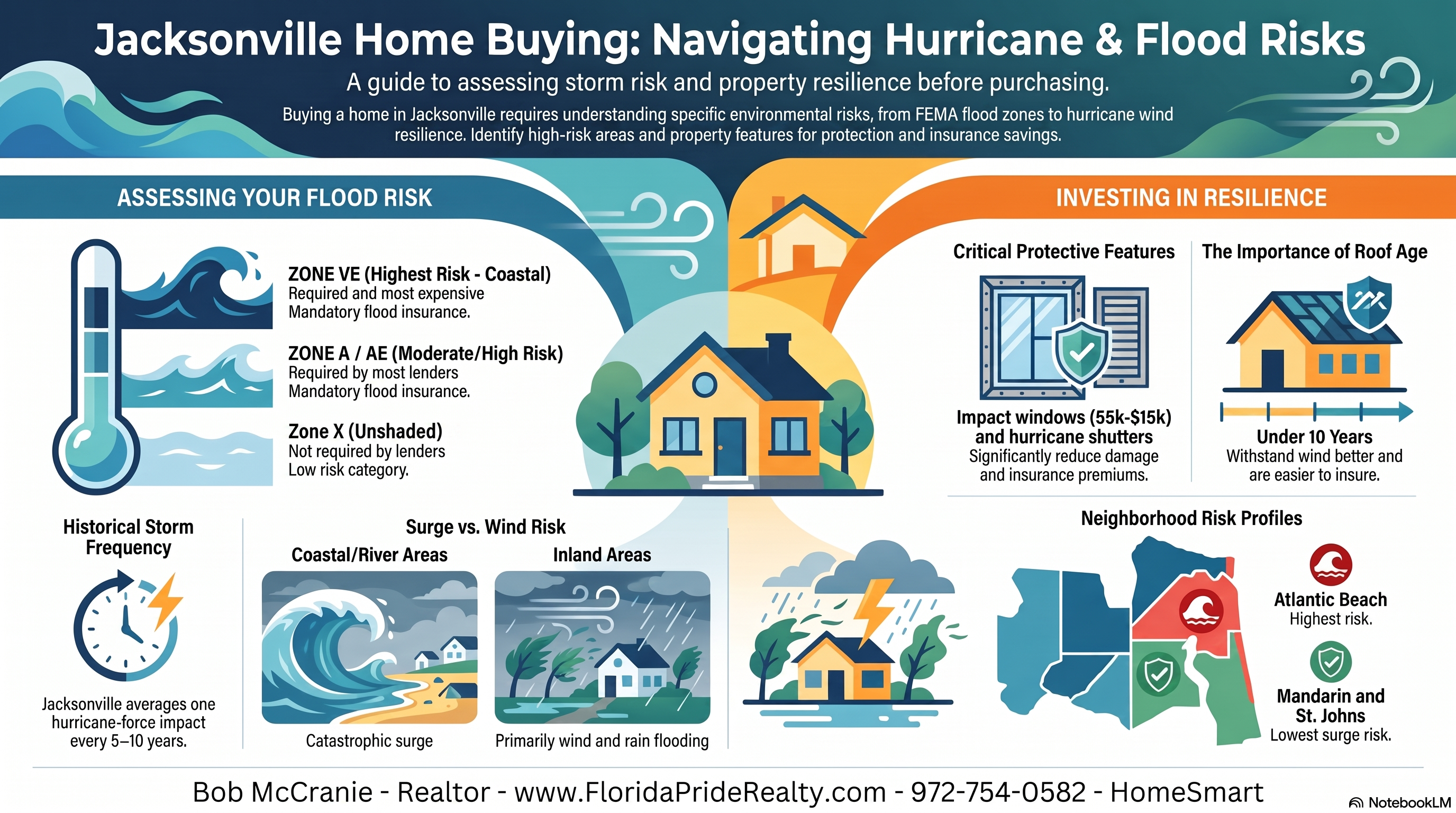
Historical context: Jacksonville averages one hurricane-force wind impact every 5-10 years. Major hurricanes (Category 3+) hit every 15-20 years. The last major hurricane impact was 2004 (Charley, Frances, Ivan all impacted the region).
Storm surge risk: Jacksonville's location on the St. Johns River and Atlantic coast creates storm surge vulnerability. Downtown and Riverside neighborhoods near the river have surge risk during major hurricanes. Atlantic Beach and Neptune Beach have ocean surge risk.
Wind risk: Entire Jacksonville experiences significant wind in major hurricanes. Wind damage is possible anywhere in the city—inland areas experience downed trees, roof damage, power outages. Outlying areas aren't safer from wind, just from surge.
Flood risk: Heavy rain from hurricanes causes inland flooding in low-lying areas. Properties near creeks and retention areas have flooding risk beyond just surge zones.
FEMA Flood Zones: Your Risk Map
FEMA flood zones are the objective measure of government-assessed risk. You need to understand yours.
Zone X (unshaded): Outside 500-year flood zone. No flood insurance required by lenders. Outlying areas like Mandarin and St. Johns are typically Zone X.
Zone A/AE: 100-year flood zone. Flood insurance required by lenders. Riverside and downtown are often Zone AE.
Zone VE: Coastal high-hazard area with velocity (storm surge) hazard. Highest risk. Flood insurance required and most expensive. Atlantic Beach oceanfront properties are Zone VE.
Check your flood zone before you buy. Don't discover it after closing.
Building Resilience Features That Matter
If you're buying in a hurricane zone, certain features meaningfully reduce risk:
Impact windows and doors. Resist wind-borne projectiles in hurricanes. Cost $5,000-$15,000 but reduce risk meaningfully and lower insurance. New construction homes usually have them. Older homes might not.
Hurricane shutters or reinforced openings. Manual or motorized shutters protect windows and doors. Less expensive than impact windows ($2,000-$5,000) but require installation and maintenance.
Roof condition and age. Newer roofs (under 10 years) withstand wind better. Older roofs are vulnerable. If buying an older home, roof age matters for hurricane season survival.
Elevated structure (if in flood zone). Homes elevated above 100-year flood elevation reduce flood risk and insurance costs. Homes on pilings are safer than homes on grade in flood zones.
Backup power capability. Generators or solar with battery backup maintain power during outages. This is increasingly valuable as outages last longer and climate extremes intensify.
Flood vents in crawlspaces. Allows water to flow through during surge rather than trapping it under homes. Homes with proper flood vents have less flood damage.
The Real-Life Hurricane Impact: What Actually Happens
Understanding theoretical hurricane risk isn't the same as understanding actual impacts:
Power outages. Hurricanes cause multi-day outages. No air conditioning in Jacksonville summer heat is dangerous. If your home isn't elevated or flood-prone, power outage is the main impact—inconvenient, not dangerous.
Storm surge flooding. If you're in a surge zone, serious flooding is possible. Homes get destroyed. Insurance covers some, but not all. Surge-prone properties experience catastrophic damage in major hurricanes.
Rain flooding. Heavy rain causes localized flooding in low-lying areas and near water bodies. Water in basements, crawlspaces, garages. If you're in a flood zone, serious rain events are problems even without hurricanes.
Wind damage. Trees fall. Roofs are damaged. Fences are destroyed. These are repairable but costly ($5,000-$30,000+ depending on damage).
Evacuation challenges. Major hurricanes require evacuation. Traffic is nightmarish. Hotels are full. Evacuation becomes a logistics problem, not just a traffic inconvenience.
How Your Location Affects Storm Risk
Different Jacksonville neighborhoods have different hurricane risk profiles:
Downtown and Riverside: River surge risk. Major hurricanes cause significant flooding. Power outages are likely. Older homes lack modern resilience features.
San Marco: Elevated location reduces surge risk relative to downtown. Still has flood risk near water features. Generally more resilient than downtown due to elevation and home quality.
Atlantic Beach and coastal areas: Highest risk zones. Ocean surge is significant. Evacuation is mandatory. Damage potential is highest. Insurance is most expensive.
Outlying areas like Mandarin and St. Johns: Lowest surge risk. Wind damage is still possible. Power outages likely. Rain flooding possible in low-lying areas, but surge flooding unlikely.
Before You Buy: The Questions to Ask
Bob McCranie's hurricane preparedness checklist for Jacksonville buyers:
-
What is the FEMA flood zone? Check before you offer. Zone VE is highest risk. Zone X is lowest.
-
What is the elevation relative to base flood elevation? Homes elevated above flood elevation have lower insurance and lower risk.
-
What is the home's age and roof age? Newer homes and newer roofs are more hurricane-resistant.
-
Does it have impact windows/hurricane shutters? These features reduce damage and insurance.
-
Is evacuation required if major hurricane hits? Some areas must evacuate. Some are sheltering zones. Know the difference.
-
What is the insurance cost reflecting hurricane risk? Higher insurance signals higher perceived risk. Understand what you're paying for.
-
What's the actual track record of this neighborhood in major hurricanes? Ask current owners. Were they affected by the last major hurricane? How?
With 45 Google 5-star reviews earned by helping Jacksonville buyers understand hurricane risk and make informed location decisions, Bob McCranie at HomeSmart ensures you buy with your eyes open about storm risk.
Contact Bob McCranie at HomeSmart | 972-754-0582 | BobMcCranie@gmail.com for a FREE 2026 Market Strategy Session